Even though it's getting to be winter, there's still planting to be done. I'm talking about cover crops. I threw down several handfuls of alfalfa seed just the other day in my own garden as well as the LBC garden. I'm afraid it might be getting too cold for them in the near future. If these fail, I should go with Austrian winter peas. I tried those last year in my own garden and they did quite well, surviving and even thriving in the bitter winter. I guess they don't call'em “winter peas” for no reason. Anyway: cover cropping is an easy way to be a good steward of the land without fouling the runoff with too much artificial fertilizer. Just a note of clarification here- I said “too much” fertilizer; I have no issue with a modicum of the stuff. I'm not one of those people... In fact, I've used it before (*gasp!*) when I tried hay-bale gardening. Thing is, it's comparatively expensive and you have to sign forms and present photo ID if you want the really good stuff. Buying some bulk alfalfa seed at Whole Foods is waaaay cheaper and it probably won't land me on a terrorist watch list. Probably. Apart from cost, the only other difference I see between artificial fertilizers and cover cropping is that you really have to do the cover crop a lot earlier than fertilizer application (I could be wrong about this, though). The upshot of that? Hmmm, it means that I get to garden even in the winter. Advantage: alfalfa.
Wednesday, November 24, 2010

Wednesday, October 27, 2010
A nice "thank you" letter

I last wrote about donating the largish squash to the Fairhaven Rescue Mission. I am very pleased to report having received a lovely letter of thanks from them. In addition to the letter, they enclosed scores of seeds from those very squash. I asked them to save me a few, maybe half a dozen or so-- just so I could be sure I had good seeds with which to grow these champs next year. I think they sent all the seeds! I'm so glad to have a renewed stock of germplasm for this squash; the seeds from which this year's crop grew were 3 years old, and I used up every last one that I had for this year's planting.
But here's the thing: there's no way that I will be able to use all those seeds next year or even over the next several years. So: if you're interested in growing lovely squash such as the one pictured here -with the proviso that at least some of what you grow goes to the food charity of your choice-email me and we'll make arrangements to get some sent to you.
Tuesday, October 5, 2010
The "Twins"

Wednesday, September 22, 2010
2010's goal has been met! (And exceeded)
This morning I dropped off a 13 pound squash at Action Ministries. That brings this season's donations to a little over 110 pounds –ten pounds in excess of our goal! Best yet is that we're not quite done with the gardens.
Also, we're starting a Fall/Winter garden- a new thing for me. I've always thought of Fall- and, especially, Winter- as categorically ungardenable seasons in my present climate zone. But there are cabbages and radishes and kale and lots of other stuff that can be grown in the cold months. I recall that last Fall and Winter, I sowed a cover crop of Austrian Winter Peas in one of my garden beds. They didn't seem to mind one bit the frigid temperatures or heavy coatings of snow inflicted upon it by the Winter. SO: I shouldn't be surprised that a great many other things can survive and indeed thrive in the inter-equinox cold.
Also, we're starting a Fall/Winter garden- a new thing for me. I've always thought of Fall- and, especially, Winter- as categorically ungardenable seasons in my present climate zone. But there are cabbages and radishes and kale and lots of other stuff that can be grown in the cold months. I recall that last Fall and Winter, I sowed a cover crop of Austrian Winter Peas in one of my garden beds. They didn't seem to mind one bit the frigid temperatures or heavy coatings of snow inflicted upon it by the Winter. SO: I shouldn't be surprised that a great many other things can survive and indeed thrive in the inter-equinox cold.
Wednesday, September 15, 2010
Almost there...
As of this morning, we've donated 97.6 pounds of produce! Only 2.4 pounds shy of our seasonal goal of 100 pounds... And although the gardens are mostly worn out, there are a few large squash (and by "large", I mean in the neighborhood of 20-30 pounds) yet on the vine. I found that a smaller squash, weighing in at about 10 pounds, produced enough usable flesh for a dozen pumpkin pies. perhaps I'll be doing a lot of baking in the near future...?
And speaking of squash/pumpkin pies, one of the folks at Action Ministries asked this morning whether the squash I delivered was a "real squash" or a pumpkin. Here's the thing: a pumpkin is a squash, but not every squash is a pumpkin. It's a bit like asking, "Is that an automobile or is it a Volkswagen?" The main upshot of this mini-digression is to make the point that the largish "gourdy" squash that you see in the produce section this time of year are perfectly suitable stand-ins for pumpkins in just about any recipe calling for pumpkins. I have only rarely made actual pumpkin pies-- I've made tons of butternut squash pies, acorn squash pies, banana squash pies, etc.
All this talk of pumpkin pies calls to mind another item to which I would call your attention, namely the needless waste of pumpkin flesh surrounding jack-o-lanterns. No, I don't have anything against those seasonal and often very clever displays. But consider using the cutout pieces of your jack-o-lantern to make a pie -and maybe even consider giving it to a needy someone-or-other. Last year I did this, using the triangular cut out pieces of the eyes and nose to make one pie and the mouth cutouts to make another. It doesn't take all that much pumpkin to make a pie, just about a cup and a half, according to my recipe.
What's that recipe?, you ask? Ok, here it is: First, you've got to cook the pumpkin flesh. Cooking time varies with the amount of flesh you've got to prepare, and I seldom cook up just a cup and a half... But I reckon if you put your jack-o-lantern cut out pieces in a dish half covered in water and microwaved it for about 4 minutes, you'd have it just about ready. You want it to be uniformly soft, such that it squashes easily under the pressure of a fork (maybe this is where the moniker "squash" comes from?). OK: so you've got some pumpkin cooked up; set it aside for a second, then go get 2 eggs, one small can of condensed milk, one of those pre-fab pie crusts and 1 tsp cinnamon, 1/2 tsp nutmeg and 1/8-1/4 tsp cardamom. Mix all that together, and be sure to save the condensed milk can. I use this to measure out how much pumpkin flesh to put in the mix. Throw in the can's worth of pumpkin and mix it up really well. Pour the mix into said pie crust, set the oven to 375°F and cook it for 50 minutes. Bam. There ya go, a darned fine punkin pie. And do consider giving it to someone who otherwise might not have some, okay?
And speaking of squash/pumpkin pies, one of the folks at Action Ministries asked this morning whether the squash I delivered was a "real squash" or a pumpkin. Here's the thing: a pumpkin is a squash, but not every squash is a pumpkin. It's a bit like asking, "Is that an automobile or is it a Volkswagen?" The main upshot of this mini-digression is to make the point that the largish "gourdy" squash that you see in the produce section this time of year are perfectly suitable stand-ins for pumpkins in just about any recipe calling for pumpkins. I have only rarely made actual pumpkin pies-- I've made tons of butternut squash pies, acorn squash pies, banana squash pies, etc.
All this talk of pumpkin pies calls to mind another item to which I would call your attention, namely the needless waste of pumpkin flesh surrounding jack-o-lanterns. No, I don't have anything against those seasonal and often very clever displays. But consider using the cutout pieces of your jack-o-lantern to make a pie -and maybe even consider giving it to a needy someone-or-other. Last year I did this, using the triangular cut out pieces of the eyes and nose to make one pie and the mouth cutouts to make another. It doesn't take all that much pumpkin to make a pie, just about a cup and a half, according to my recipe.
What's that recipe?, you ask? Ok, here it is: First, you've got to cook the pumpkin flesh. Cooking time varies with the amount of flesh you've got to prepare, and I seldom cook up just a cup and a half... But I reckon if you put your jack-o-lantern cut out pieces in a dish half covered in water and microwaved it for about 4 minutes, you'd have it just about ready. You want it to be uniformly soft, such that it squashes easily under the pressure of a fork (maybe this is where the moniker "squash" comes from?). OK: so you've got some pumpkin cooked up; set it aside for a second, then go get 2 eggs, one small can of condensed milk, one of those pre-fab pie crusts and 1 tsp cinnamon, 1/2 tsp nutmeg and 1/8-1/4 tsp cardamom. Mix all that together, and be sure to save the condensed milk can. I use this to measure out how much pumpkin flesh to put in the mix. Throw in the can's worth of pumpkin and mix it up really well. Pour the mix into said pie crust, set the oven to 375°F and cook it for 50 minutes. Bam. There ya go, a darned fine punkin pie. And do consider giving it to someone who otherwise might not have some, okay?
Thursday, August 12, 2010
Dog days of summer
These are the dog days of summer, at least here in Northern Kentucky. Blimey, it's been hot and harsh lately. The weather notwithstanding, we're now up to a little more than 70 lbs of produce donated! An increasing proportion of this is coming from the LBC garden, and that is a good sign for future seasons. I just harvested a couple pounds of nice big tomatoes from the LBC plot this morning and there are a few more that will be ready in a day or so.
Although the end of summer is in sight, the end of the garden is not. I just attended a seminar at the Civic Garden Center in Cincinnati about Fall gardening. There is a good number of things that can be planted now and in the weeks to come. The one I look forward to growing is carrots. Root crops, so I'm told, yield the highest nutritional value per square foot of gardening space of all crops. Bearing this in mind, next year we'll be trying potatoes too.
And speaking of next year: if you are interested in doing a little bit of good for hungry folks, drop me a line and we can chat about getting you a grow-box for you to manage next year. It's easy and very rewarding!
Although the end of summer is in sight, the end of the garden is not. I just attended a seminar at the Civic Garden Center in Cincinnati about Fall gardening. There is a good number of things that can be planted now and in the weeks to come. The one I look forward to growing is carrots. Root crops, so I'm told, yield the highest nutritional value per square foot of gardening space of all crops. Bearing this in mind, next year we'll be trying potatoes too.
And speaking of next year: if you are interested in doing a little bit of good for hungry folks, drop me a line and we can chat about getting you a grow-box for you to manage next year. It's easy and very rewarding!
Wednesday, July 28, 2010
A little more
We're now at a little over 46 lbs of produce donated now. The container garden has supplied the bulk of this produce, but as the plants in the LBC garden mature and begin to produce, they'll begin to make a larger proportional contribution. I've set a goal of 100 pounds of produce for this year; I don't know if that is a reasonable goal, but it certainly could be. I've also taken a few things here and there from my own garden -mostly things of which we have plenty and can therefore do without.
And speaking of my garden, here are a few looks at what's growing there. I have to say, the plot is much smaller now than when I started planting it...
I've got an abundance of these little currant tomatoes. I'm not partial to tomatoes generally, but these are quite good. Note their size!

 I've harvested many pounds of goldenberries by this time. Wow, these plants are producing so well. It seems like every evening I go out to the garden and find another couple dozen have ripened.
I've taken several dozen and strung them up to dry (and, for some, ripen up completely) in the garage. Fresh or “raisinified”, they're delicious. I took some and dipped them in chocolate; that came out pretty well. I'll have to make a few batches to send off for Christmas gifts.
Here is a look at what we call our “Godiva” gourds- so called because the seeds, having no hard hull, are “naked”.

We let the gourds grow to maturity, then pull out all the seeds (the flesh goes into the compost heap, naturally). Then we clean them, give them a salt bath and roast them. This is an especially welcome treat for our little girl who, owing to a nut allergy, can't otherwise have any kind of nuts at all.
This irksome looking beast is called a “lytchi tomato”.

While it is in the Nightshade family -as are tomatoes- it is no kind of tomato in reality. It's much closer, botany-wise, to the eggplant, its genus being Solanum (species sisymbriifolium). The fruits are small red berries and they have a mildly sweet flavor.
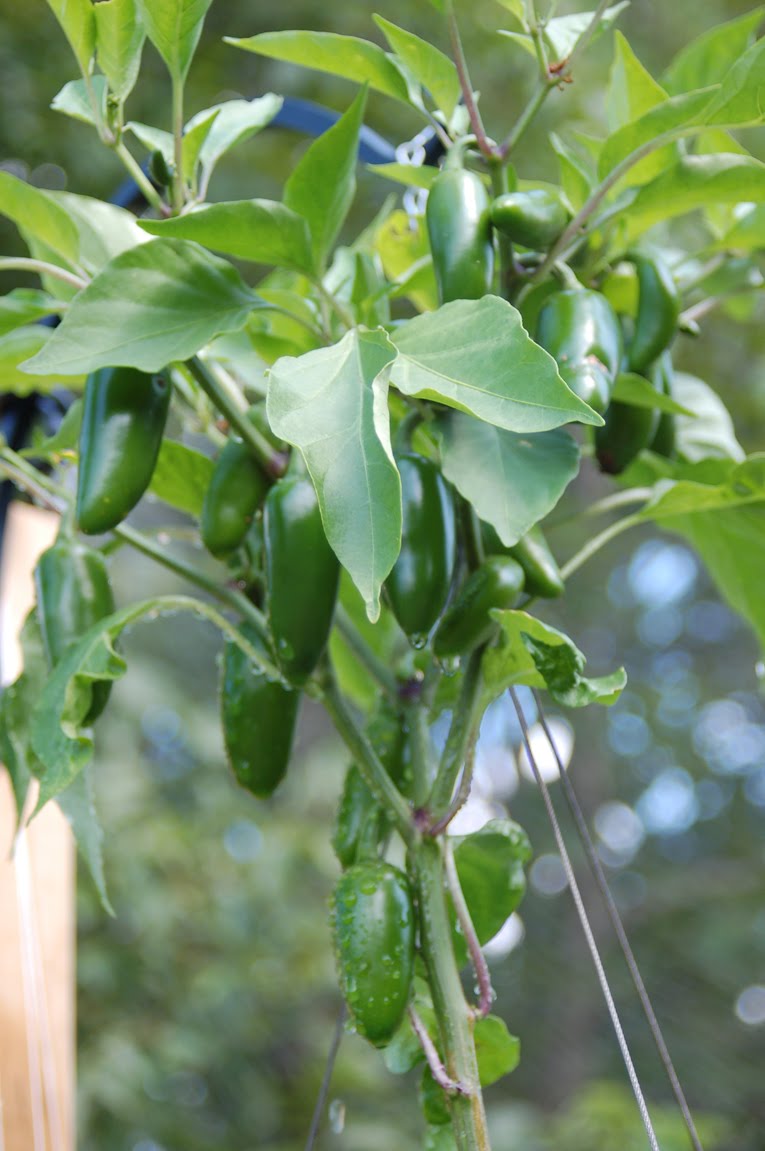
And here is a look at some peppers I have growing.


Subscribe to:
Posts (Atom)